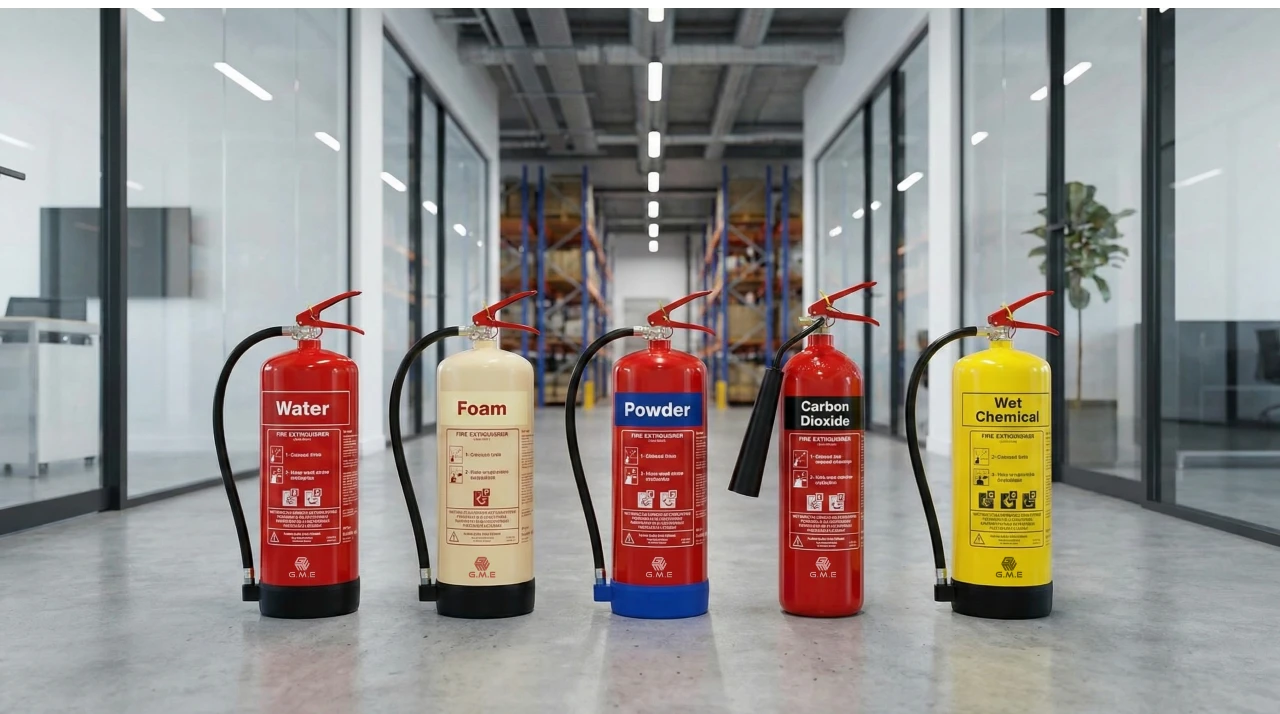
Types of fire extinguishers, their colour codes, and their correct usage.
It’s Not Just a Red Can. Using the Wrong Fire Extinguisher Could Be Fatal.
Matching the Extinguisher to the Risk is a Legal & Safety Necessity. In an emergency, seconds count. Grabbing the nearest fire extinguisher without knowing if it’s the right type for the fire can make the situation drastically worse.
As a business owner or manager in Ireland, you have a legal duty under the Safety, Health and Welfare at Work Act to provide adequate firefighting equipment. This guide breaks down the classes of fire and the specific extinguishers required to fight them safely.
Ensure your premises are compliant with Irish Standard I.S. 291.
Before looking at the extinguishers, you must understand what they are fighting.
In Europe and Ireland, fires are classified by the type of fuel involved.
Class A: Solid materials (Wood, paper, cardboard, textiles).
Class B: Flammable liquids (Petrol, diesel, oils, paints).
Class C: Flammable gases (Propane, butane, natural gas).
Class D: Flammable metals (Magnesium, aluminium swarf – usually industrial risks).
Class F: Cooking fires (Deep fat fryers, cooking oils and fats).
Electrical Risk: (Not officially a 'Class', but a critical category). Fires involving live electrical equipment (Computers, servers, fuse boards).
All modern fire extinguishers in Ireland have a red body.
The critical differentiator is the coloured band near the top, which indicates the contents.
Here is a breakdown of the most common types found in Irish commercial premises:
1. Water Extinguishers
(Visual Cue: extinguisher with a solid RED band/label.)
Colour Code: Solid Red.
Best For: Class A Fires only (Wood, paper, fabrics).
How it works: Cools the fire, removing the heat needed to sustain it.
Typical Use: General office areas, retail spaces, schools.
DANGER⚠️: NEVER use on liquid, electrical, or chip pan fires.
2. Foam Extinguishers (AFFF)
(Visual Cue: Extinguisher with a CREAM coloured band.)
Colour Code: Cream.
Best For: Class A and Class B fires.
How it works: Forms a blanket over burning liquids, cutting off the oxygen supply, and cools burning solids.
Typical Use: A versatile choice for offices, warehouses, and petrol stations.
NOTE⚠️: While safer than water, they should ideally not be used on live electrical equipment (though many modern ones have passed a 35kV dielectric test for accidental spray).
3. Carbon Dioxide (CO2) Extinguishers
(Visual Cue: Extinguisher with a BLACK coloured band and a distinctive black "horn" nozzle.)
Colour Code: Black.
Best For: Electrical Risks and Class B liquids.
How it works: Displaces oxygen, suffocating the fire. It is a "clean agent" leaving no residue, making it perfect for sensitive equipment.
Typical Use: Server rooms, offices with many PCs, electrical switch rooms.
WARNING⚠️: Do not hold the horn during discharge (risk of cold burns). Not suitable for deep fat fryers. Not effective on Class A fires (they may re-ignite once the gas dissipates).
4. Dry Powder Extinguishers (ABC)
(Visual Cue: Extinguisher with a BLUE coloured band.)
Colour Code: Blue.
Best For: Multi-purpose use on Class A, B, C, and Electrical fires.
How it works: Coats the fuel with a fine powder, chemically inhibiting combustion.
Typical Use: Boiler rooms, industrial sites, garage forecourts, exterior areas.
DANGER⚠️: Not recommended for indoor use (unless specific risk assessment dictates). The powder ruins electronics, causes respiratory issues if inhaled, and massively reduces visibility, hindering escape efforts.
5. Wet Chemical Extinguishers
(Visual Cue: Extinguisher with a YELLOW/CANARY coloured band. Often has a long lance applicator.)
Colour Code: Yellow.
Best For: Class F (Cooking Oils/Fats) and usually Class A.
How it works: Creates a chemical reaction with the burning oil (saponification), turning it into a non-flammable soapy layer and cooling it down.
Typical Use: Commercial kitchens, canteens, restaurants.
NOTE: The only safe extinguisher for deep fat fryers. Water or foam will cause an explosive reaction.
The Critical Warnings
If you remember nothing else, remember these two rules. Misusing extinguishers on these fires frequently causes severe injury or death.
RULE 1: NEVER use Water on an Oil/Fat Fire (Class F) The water will sink below the oil, instantly vaporize into steam, and expand violently, ejecting burning oil over the user and the room. Only use Wet Chemical.
RULE 2: AVOID Water/Foam on Live Electrics Water conducts electricity. Using it on live switchgear or appliances can send a lethal shock back up the stream to the user. Always use CO2 for electrical risks.
It’s Not Enough to Just Buy Them.
Having the correct extinguisher is step one. Ensuring it works when needed is step two.
Under Irish Standard I.S. 291:2015, all portable fire extinguishers must be:
Commissioned on-site by a competent person upon delivery.
Visually inspected monthly by the user (checking pressure gauges and seals).
Serviced annually by a competent, certified engineer.
Test Discharged/Refilled every 5 years (or 10 years for CO2).
At GME Fire & Security, our engineers are fully qualified to perform I.S. 291 assessments, installations, and annual maintenance, ensuring your logbooks are ready for inspection by the fire officer.