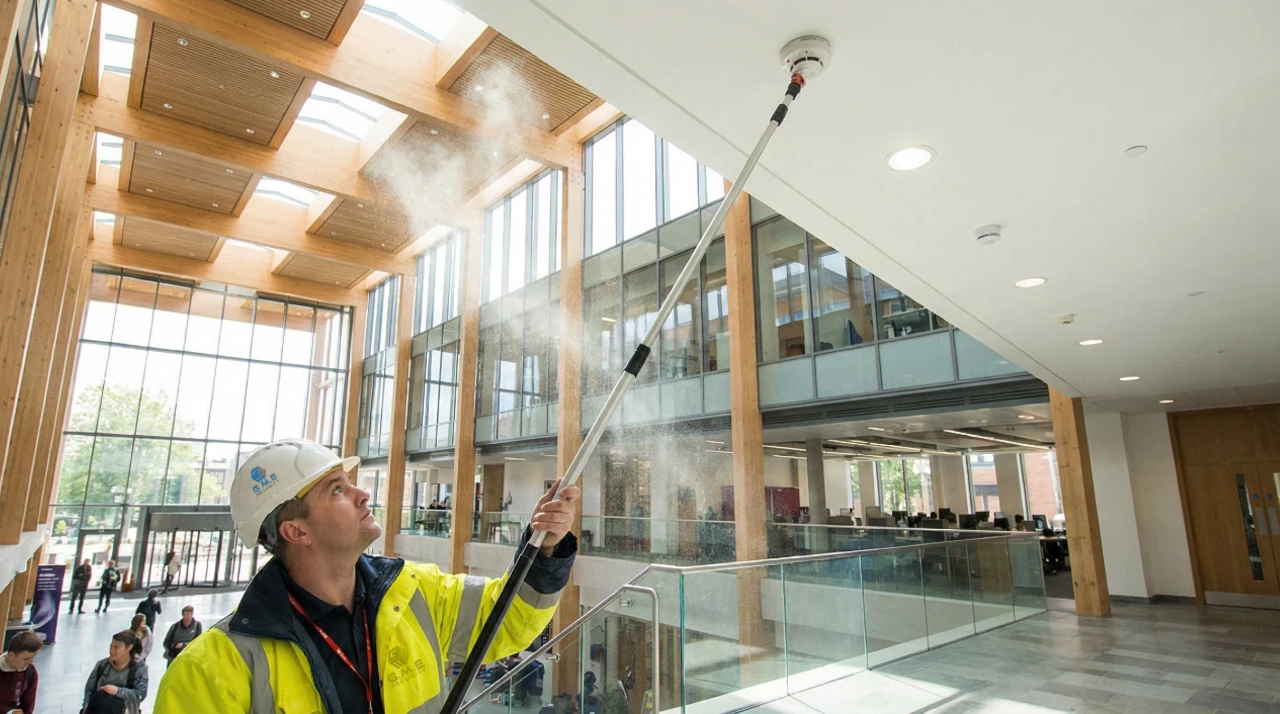
Comprehensive Fire System Inspection, Testing, and Commissioning services.
We provide the independent verification you need to meet IS 3218, IS 3217, and Insurance requirements.
The Certificate is Your Protection. Under the Fire Services Act 1981 & 2003, the "Duty Holder" is liable if safety systems fail. A maintenance contract is not enough; you need rigorous, documented testing.
Commissioning: The vital step before handover. We ensure the system acts exactly as the design drawings specify.
Periodic Inspection: Independent audits to check if your current maintenance provider is actually testing the system or just "ticking the box."
Insurance Validation: Many insurers now demand an independent "Health Check" of fire systems before renewing policies for high-risk sites.
Fire Alarm Commissioning
Verification to IS 3218.
Cause & Effect Testing: Does the AC shut down? Do the magnets release? Do the lifts ground? We test every interface.
Audibility Testing: We measure decibel (dB) levels in every room to ensure the alarm wakes sleeping occupants (75dB at bedhead).
Loop Integrity: Testing cabling resistance and insulation to prevent future faults.
Emergency Lighting (IS 3217)
Don't Be Left in the Dark.
Lux Level Testing: We use calibrated light meters to ensure escape routes meet the minimum 1 Lux requirement on the center line.
3-Hour Drain Test: Verifying that batteries actually last the full duration required by law.
Photometric Design: Verifying that the installed lights match the original design intent.
Room Integrity Testing
For Gas Suppression Systems.
Door Fan Testing: Essential for Data Centers and Server Rooms. We pressurize the room to calculate how long the gas will stay in the room (Hold Time).
Leak Detection: If the room fails, we use thermal cameras and smoke pencils to find the air leaks.
Fire Extinguisher Audits (IS 291)
Right Place, Right Type.
Discharge Testing: Random sampling discharge tests to ensure units work.
Suitability Audit: Checking that you don't have water extinguishers next to electrical risks.
A Transparent Path to Compliance.
The Survey: We review your "As-Installed" drawings and Fire Safety Certificate.
The Test: Our engineers arrive with calibrated equipment (Sound meters, Lux meters, Smoke testers).
The Report: You receive a detailed pass/fail report highlighting non-compliances (e.g., "Sounder volume too low in Room 101").
The Certification: Once compliant, we issue the formal Certificate required for your Fire Register.
First, an audit is carried out to review system design, installation, and maintenance records against Irish standards such as IS 3218 and EN 54. Next, the system is tested through functional checks of detectors, alarms, panels, and emergency lighting to verify performance under real conditions. Finally, once all requirements are met, the system is certified, providing official documentation that the premises are protected, legally compliant, and ready for inspection by Fire Officers or insurers. This process gives building owners confidence that their fire safety measures are both effective and auditable.
Engineering Integrity.
Calibrated Equipment: All our test devices are calibrated annually by an accredited lab. You can't test safety with guesswork.
Independent Advice: If we didn't install it, we have no reason to hide faults. We give you an honest assessment of your system's health.
Designated Engineers: Our testing team focuses solely on commissioning and inspection—they are experts in the regulations.
Verifying Safety Across Ireland
"We needed an independent commissioning certificate for a new office block in Sandyford before the tenants could move in. GME identified three critical cause-and-effect failures that the installers had missed. Their thoroughness saved us from a potential disaster."
— Project Manager, Tier 1 Construction Company